The Spanish you meet living in Spain
Remember the Spanish
you actually hear.
At the pharmacy, on a call with the landlord, buried in the paperwork — a word goes past that you don't know. Say it out loud and keep going. It comes back as a card set in the moment you caught it, then again just before you'd forget.
About a minute to set up · No account needed to try
- ~15
- unknown words in an afternoon out
- <5s
- to catch one without stopping
- 5
- spaced reviews before it sticks
The problem
Your words, not a list
someone else wrote.
The words worth learning already found you — in the pharmacy queue, on a call with the landlord, in something a neighbour said twice before you admitted you didn't know it. Looking one up costs you the moment. Not looking it up costs you the word. Most people pick the moment, every time, and that is the right call — it just leaves nothing behind.
One ordinary day
- Words you meet and don't know
- ~15
- Words you stop to look up
- 1–2
- Words you still know next week
- 0
How it works
Four seconds, then nothing.
No deck to build, no cards to write, no evening set aside for review. The work is a word said out loud and two minutes a day.
- 01
Keep doing what you're doing
Name it for wherever you are — the pharmacy, a flat viewing, the town hall, a call with the landlord. Catchword sits in the background and does nothing until you need it.
- 02
Say the word
A word goes past that you don't know. Say it out loud. That's the entire interaction — under five seconds, without leaving the moment you're in.
- 03
The card writes itself
Translation, part of speech, a plain definition, and examples set in whatever you were doing when you caught it. You didn't type anything.
- 04
It comes back five times
One day, three days, a week, two weeks, a month. You answer before you're shown. That order is what moves it into memory.
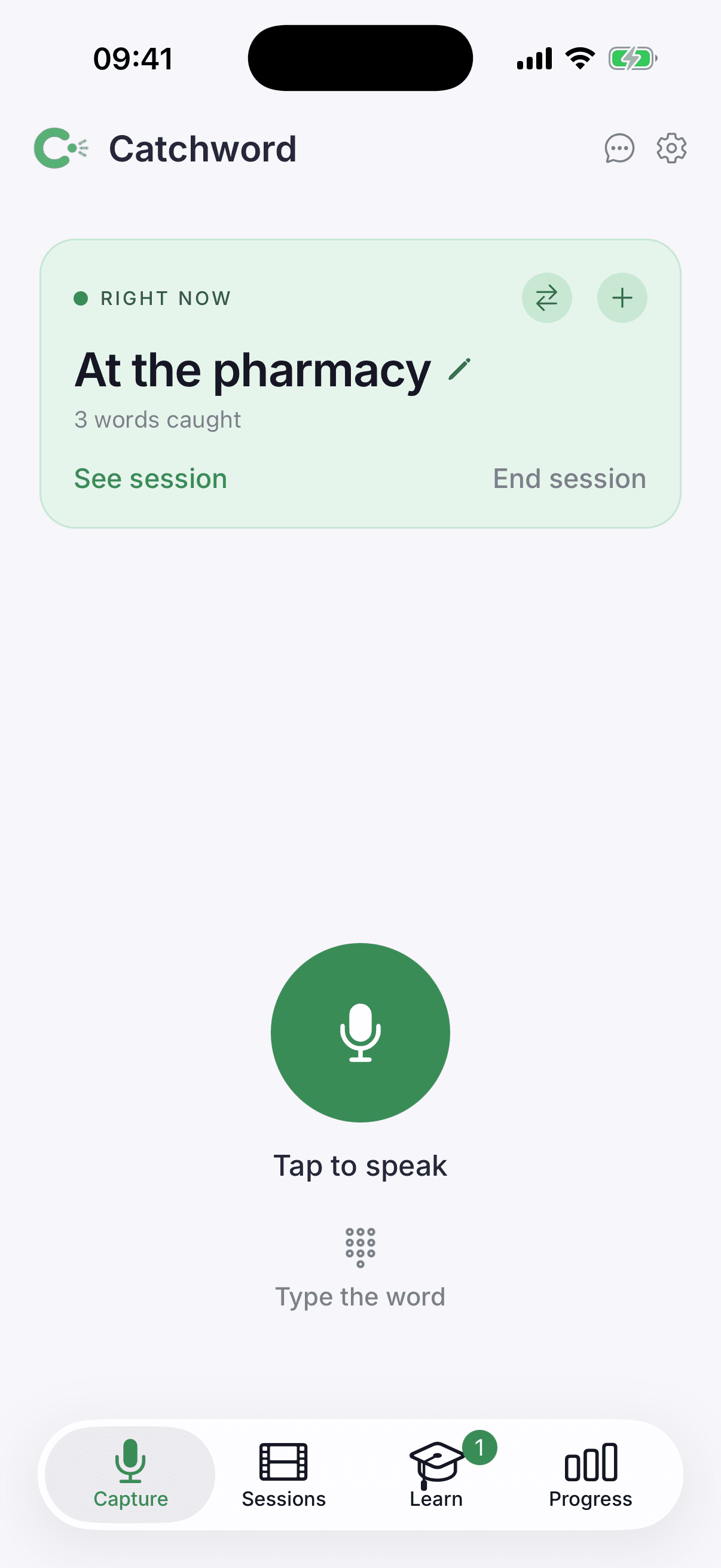
Capture
Your voice is the whole interface.
Say the word. No pausing, no typing, no asking anyone to repeat it. The one thing standing between hearing a word and keeping it is effort, so we removed almost all of it. Speak it in any of sixty languages, and read it back in any of the other fifty-nine.
Works on words you can't spell — which, for a word you've only ever heard, is most of them.
Context
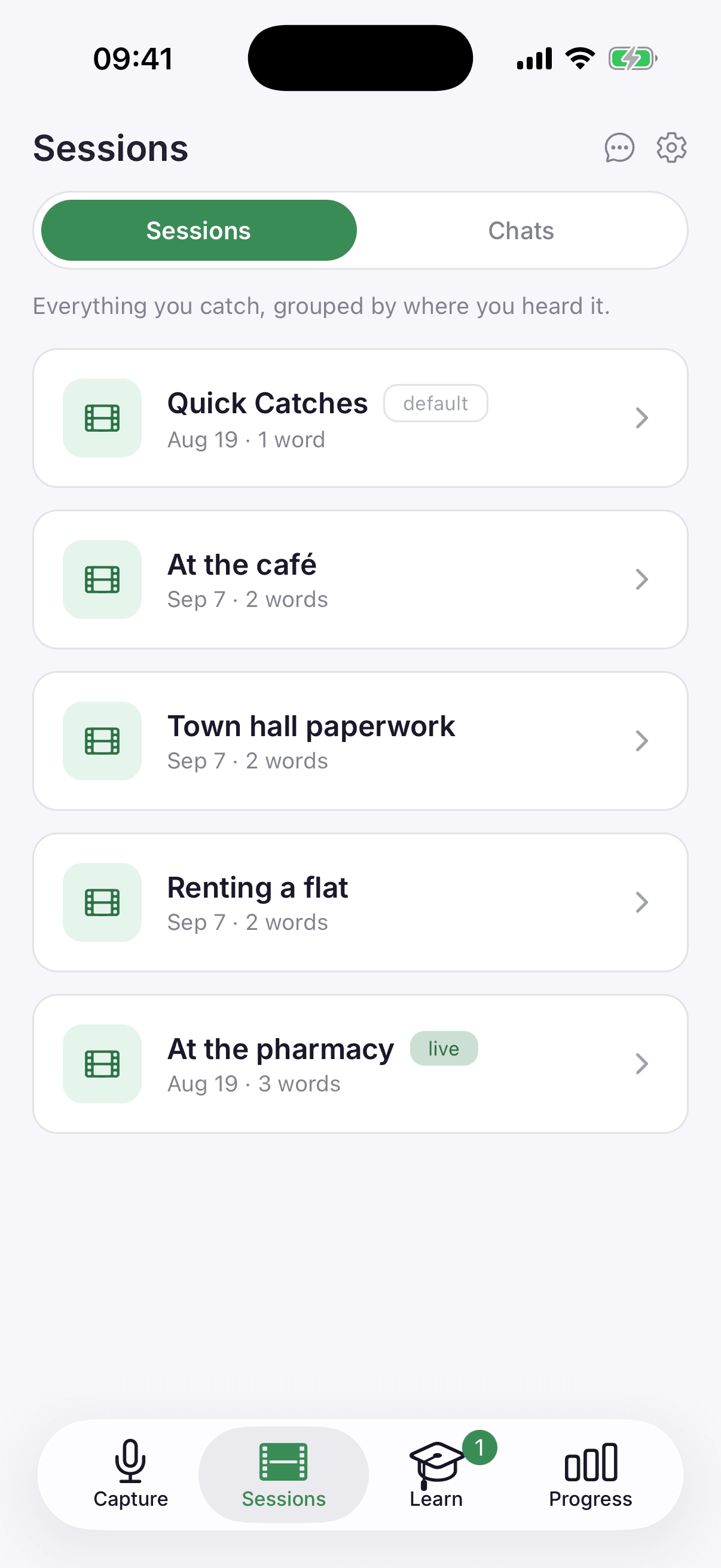
Every word remembers where it came from.
Cards are set in whatever you were doing when you caught the word, not in a generic sentence from a textbook. You don't recall 'relentless' — you recall the wave in the film that never let up.
Provenance is most of why a word sticks. Stripping it out is the quiet mistake every word list makes.
Recall
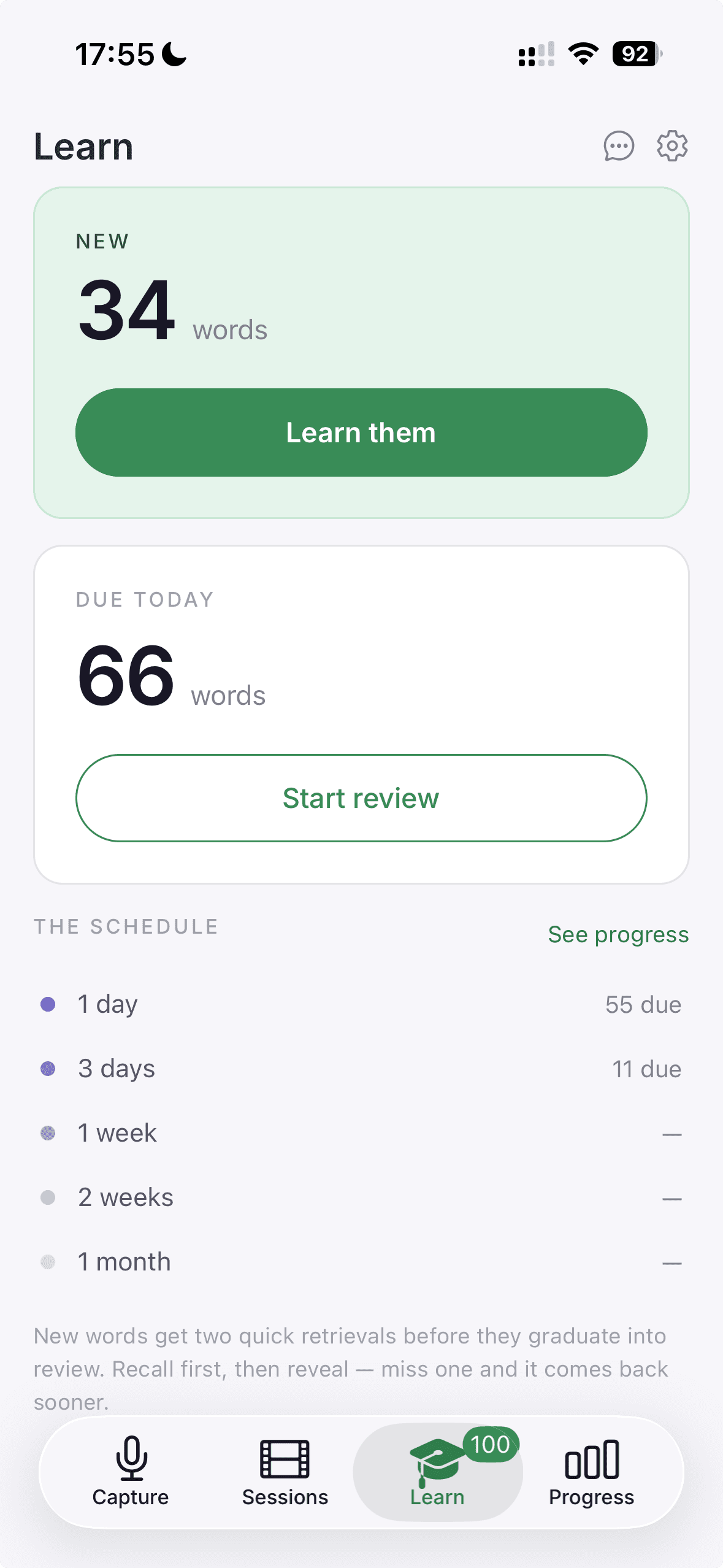
Answer first. Then find out.
Every review asks before it shows. Retrieving a word — even failing to — is what moves it into long-term memory; rereading it does close to nothing.
One day, three days, a week, two weeks, a month. You never choose an interval; forgetting is predictable enough that we can schedule against it.
The method
Forgetting is predictable.
We schedule against it.
Built on the boring, replicated stuff.
None of this is novel. It is the part of the research that survived replication, implemented properly instead of gamified into streaks.
Successive relearning
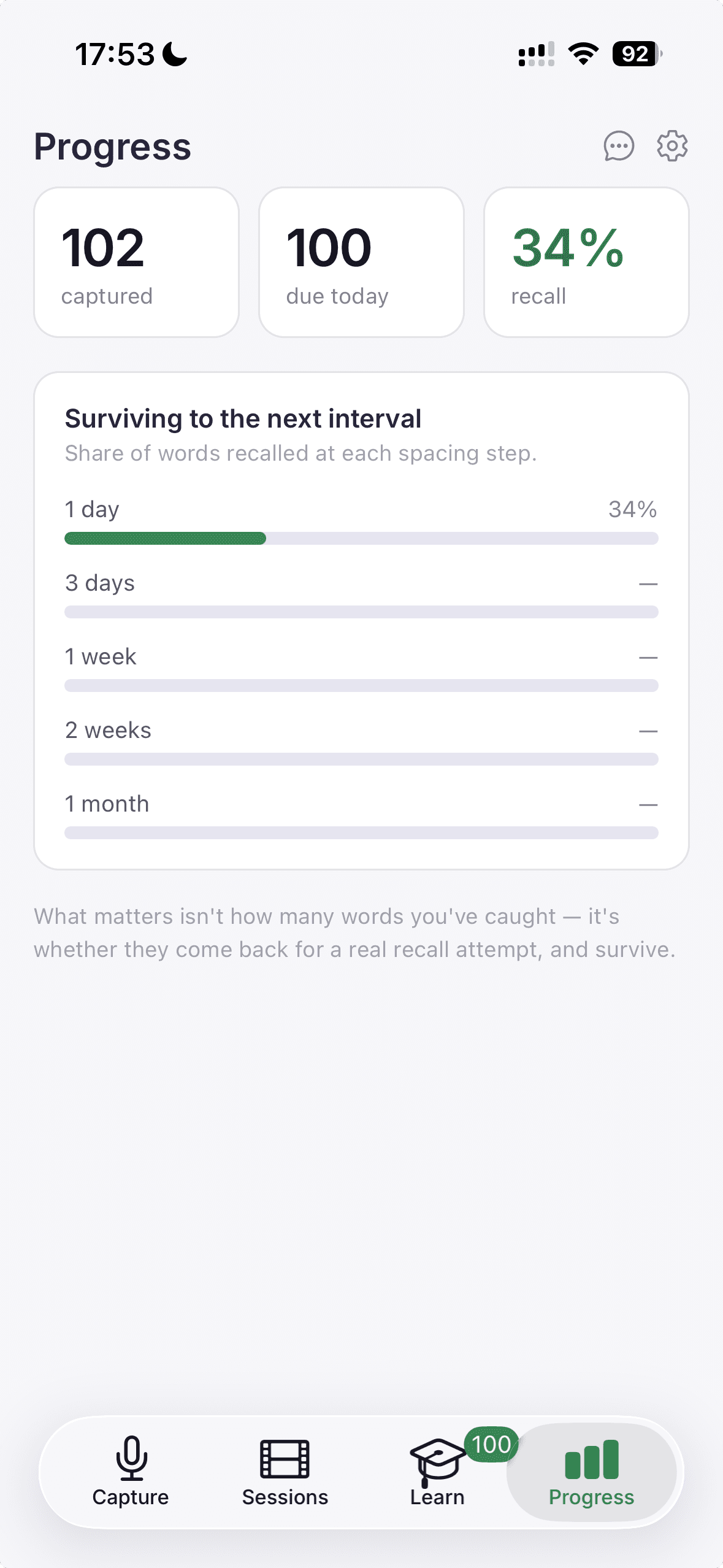
Not one study session, but the same word retrieved correctly across several sessions spread over weeks. It is among the most reliably replicated findings in learning research, and almost nothing consumer-facing implements it properly.
Retrieval before reveal
Being shown a word teaches you that you recognise it. Being asked for it teaches you whether you know it. Only the second one builds recall, so every review is a question first.
Immediate feedback
The answer arrives the moment you commit to one. A wrong guess corrected within a second is worth more than a right one you were never sure about.
Pricing
Seven days free. Then every word.
Start on the web with your email — no card. After the trial, Pro is €9.99 a month, or €59.99 for the year — about €5.00 a month.
7 days free · no card to start
Catchword Pro
Every word you catch, kept and scheduled until you know it.
€59.99 / year
€5.00 a month, billed yearly
€119.88 → save €59.89
- Catch every word you meet — no cap, no counter
- An AI card for each one, made in seconds
- Examples set in whatever you were watching, reading or doing
- A spaced review schedule that brings each word back until it sticks
- Synced across every device you sign in on
Start free for 7 days on the web with just your email — no card. After the trial, €59.99 a year. Cancel any time.
Prices in euro and final — no VAT is added (Section 19(1) UStG). In the App Store and on Google Play you pay the price your store shows for your country, and the trial there asks for a payment method up front.
Questions
The things people ask.
Is this only for movies?
It started that way, and an evening of film is still the densest source there is — which is why most of what you see here is filmed in one. But a session is only a name: a podcast, a stand-up, a call with a colleague, a chapter you're halfway through. You catch a word the same way wherever you are, and the card is set in whatever you called it.
How is this different from Anki?
Anki is a scheduling engine that assumes you'll make the cards. Most people stop making them within a fortnight — that's the failure mode, not laziness. Catchword removes card-making entirely: you say a word and the card exists. The scheduling underneath is the same well-tested idea.
Do I have to stop what I'm doing?
No. Saying a word takes under five seconds and you don't step out of the moment to do it. The card is generated while you carry on, and it's waiting for you afterwards.
Which languages does it support?
Around sixty, in any combination. You pick the language you're learning and the language you'd like to read translations in — English for a Brazilian, Japanese for a Spaniard, whichever way round you need. Cards are written for the pair you chose rather than pulled from a fixed dictionary, so no combination is second-class.
What if it mishears me?
You can correct a word before the card is generated. Accents and background audio being what they are, this happens — it's a two-second fix, not a lost word.
Does it work offline?
Reviews do — your cards are on the device. Catching a new word needs a connection, since the card is generated server-side.
What happens to my data?
Your words and where you caught them are yours; we don't sell them or train public models on them. Audio is transcribed and discarded rather than stored. The full detail is in the privacy policy.
The next word you don't know
is about ninety seconds away.
Build your plan, catch one word, and see what the card looks like. It takes about a minute and costs nothing.